

What if the most valuable data is what customers don't express directly?
It was around this question that Igonogo gathered clients, experts, and partners at the Customer Emotion Summit 2026, an event dedicated to a topic that is gradually transforming how we understand consumers: emotions.
Long perceived as difficult to measure, emotions are now playing a new role in business decisions. They no longer just enrich an analysis; they enable better decision-making, more effective prioritization, and the anticipation of what will truly make a difference for a customer.

At this edition, Candice François and Florian Loeser reiterated Igonogo's mission: to help companies make more reliable decisions through more comprehensive data in surveys.
Their conviction is to make neuroscience accessible to businesses, and by combining human expertise and technology, it becomes possible to better understand what consumers truly feel.
This approach allows going beyond traditional responses, without complicating the experience for respondents.
Emotions as a Business Driver
The discussions were then opened by Angélique Gérard and Candice François around a powerful idea: emotions are not merely an added bonus. They are a true driver of performance.
An entrepreneur, investor, and speaker, Angélique Gérard is notably known for having played a major role in the development of Free and the Iliad group, where she managed subscriber relations for over twenty years. Today, committed to entrepreneurship, innovation, and the role of women in tech professions, she shared her vision of the role of emotions in business performance.
In a context where organizations already have a wealth of customer data, a crucial part of the decision-making process often remains invisible. Customers don't always know how to explain what they feel. They don't always articulate their doubts, preferences, or hesitations. Sometimes, what they state isn't enough to understand what will truly guide their choice.
Emotion then becomes a business topic because it helps to interpret what lies behind a purchase intention, a brand perception, or a user experience.
A Panel Discussion with L’Oréal, IFF, and Salomon
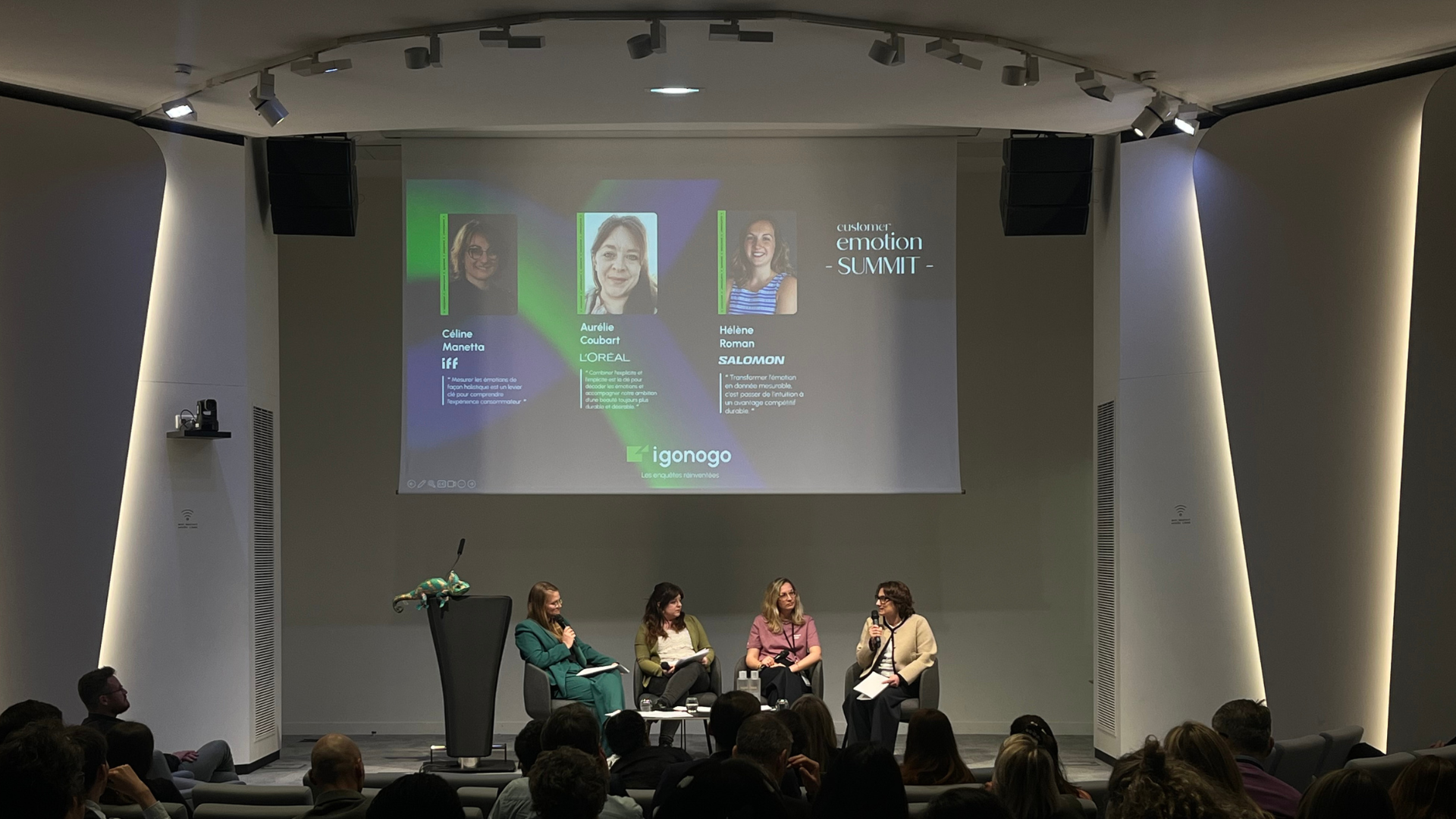
The highlight of the event was the panel discussion titled "Understanding What Customers Don't Say," moderated by Candice François.
Alongside her, three Igonogo clients shared their feedback: L’Oréal, IFF, and Salomon. Three different worlds, three ways of using emotional insights, but one common observation: explicit statements alone don't tell the whole story.
At L’Oréal, emotion complements functional performance. In highly competitive markets, a product must not only be effective. It must also create an experience, generate engagement, and leave the right impression.
At IFF, a major player in fragrance creation, emotion is at the heart of the product. However, the discussions also showed that a product might not be highly rated at first glance, yet still reveal a very strong emotional territory. These signals help avoid discarding a creative avenue too quickly and identify potential that traditional scores aren't always enough to reveal.
At Salomon, the emotional approach helps illuminate the user experience in a world often associated with technicality, performance, and product. It helps distinguish genuine pain points from internally overestimated issues, and prioritize product investments where they will have the most impact.
Complement, don't replace, declarative data
One of the key messages from this roundtable is that it's not about pitting declarative against implicit.
Declared responses remain valuable. They help us understand what consumers articulate and explain. But when it comes to emotions, some information naturally eludes words.
Consumers might rationalize a preference after the fact, respond with what they think is expected, or say they like a product without actually being ready to buy it.
By capturing implicit signals during the response experience, Igonogo complements this understanding. The goal: to obtain more nuanced data, closer to real feelings, and above all, more useful for decision-making.
This is where ROI becomes tangible: less uncertainty when making choices, fewer complacency biases, less overinvestment in areas that aren't priorities for consumers.
Brands that get ahead are those that know how to listen differently. Those that seek to capture unspoken cues, hesitations, and weak signals. Those that transform this information into concrete decisions for their products, services, and experiences.
A big thank you to Angélique Gérard, Hélène Roman, Aurélie Coubart, and Céline Monetta for sharing their insights and the authenticity of their feedback.
Emotions are no longer just a subject of study. They are becoming a decision-making tool.
.png)
%20(1).png)
.png)