

All businesses aim to attract new customers. However, the most successful ones are often those that can extend relationships over time and build lasting preference. In a context of rising acquisition costs, understanding the mechanisms that influence loyalty and retention has become a strategic lever for sustaining profitable growth.


The Lifetime Value (LTV), Customer Lifetime Value (CLV) or customer lifetime value in English, measures the revenue or margin a customer generates throughout their relationship with a company. It's a strategic indicator: it helps determine how much to invest in acquisition and retention, prioritize high-value segments, and manage long-term profitability. Traditionally calculated using behavioral and financial data, CLV is nonetheless profoundly influenced by an often-overlooked factor: emotions.
Cognitive science and neuromarketing have profoundly transformed our understanding of purchasing behavior. They demonstrate that most of our decisions are not based on rational analysis, but are guided by unconscious and emotional processes. The experience with a brand, the positive memories it creates, the feeling of trust or belonging it inspires—these are all invisible levers that extend the relationship and increase customer lifetime value.
In this article, we will precisely define Customer Lifetime Value and explain the methods for calculating it. We will then explore how emotions shape loyalty and directly influence this metric, before analyzing how to apply persuasion levers and neuromarketing insights to sustainably increase customer lifetime value, supported by real-world examples.

The Customer Lifetime Value (CLV), also known as Customer Lifetime Value (CLV) or CCLV, is the total value a customer generates for a business throughout their entire relationship with the brand. It can be expressed in revenue or, more precisely, in net margin, depending on the objective of the analysis.
Several calculation approaches can coexist:
• CLV = Average Revenue Per Customer × Average Lifespan
• CLV = Average Order Value x Purchase Frequency x Customer Lifespan
Customer lifespan simply refers to the period during which a consumer remains loyal to a company. But how is it calculated?
Lifespan = 1 / customer churn rate
TheAttrition (also known as churn) represents the proportion of customer loss for a company. The attrition rate is a key KPI to monitor closely. It is also closely linked to customer satisfaction, loyalty, and experience. It is calculated as follows: Churn = (Number of lost customers over the period / Total number of customers at the beginning of the period).
Why is this strategic ? Because LifeTime Value helps determine how much to invest in acquisition (CAC - Customer Acquisition Cost) without harming profitability, to prioritize high-value customers, and to guide long-term strategy. It is recommended that the maximum CAC be one-third of the CLV.
Let's take a concrete example for a SaaS software company:
• Customers at the beginning of the month: 1,000
• Customers lost during the month: 50
• Average order value (monthly): 35 €
• Purchase frequency : 1 (subscription billed monthly)
50 customers / 1000 customers = 0.05, i.e. 5%
1 / 0.05 = 20 months
35 €×1×20= 700 € per customer
To be adjusted with an 80% margin: 700 € x 80% = 560 €
560 € / 3 = 187 €
To give an idea of the scale, here is a projection based on monthly churn. This highlights the importance of customer retention for profitability and for the budgets allocated to customer acquisition.
Average monthly spend: €35 | Frequency: 1/month | Rule: CLV/CAC ≥ 3
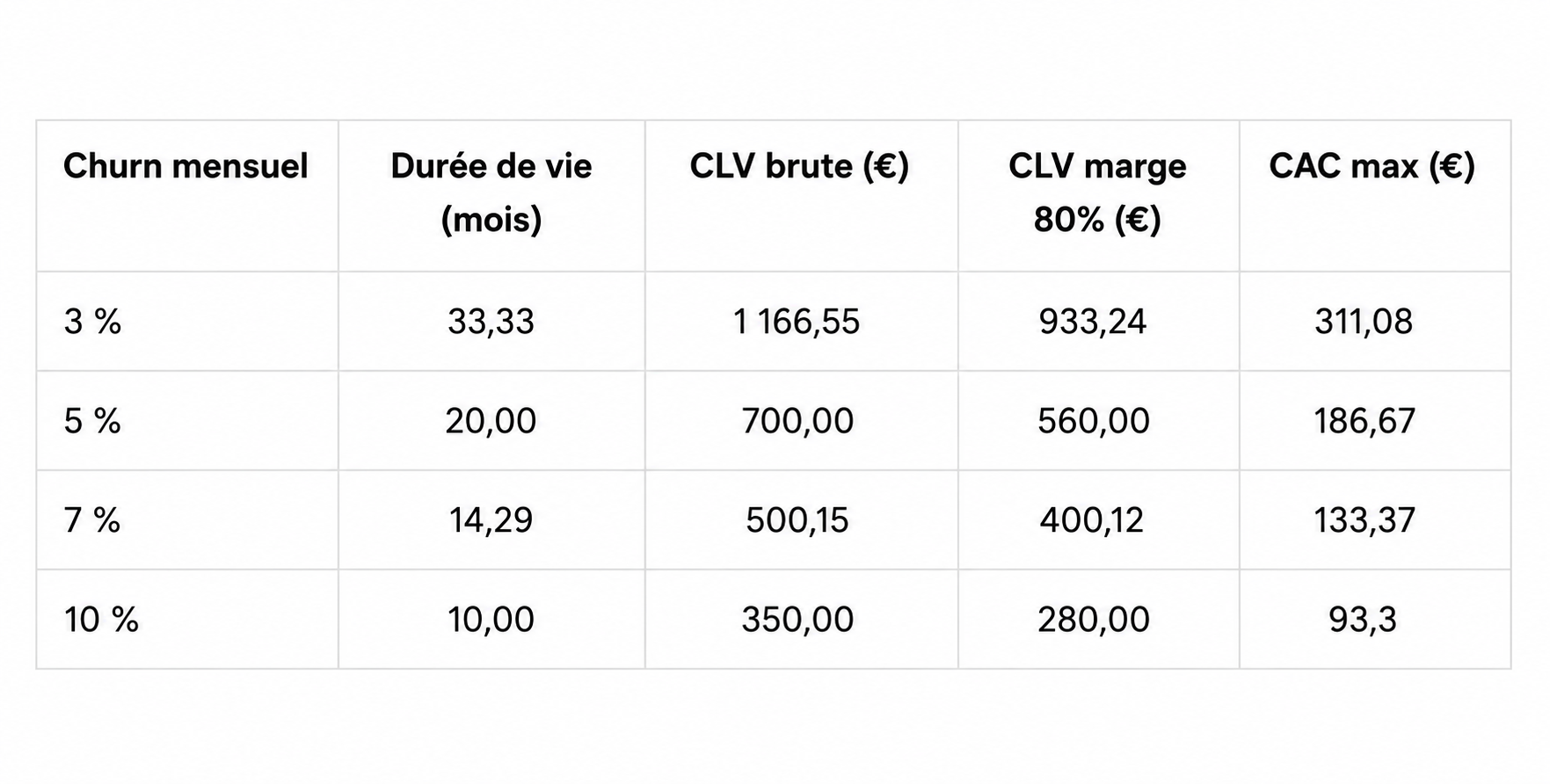
The Customer Lifetime Value is one of the most powerful metrics for tying marketing to financial results.
It notably allows you to:
• Define a maximum Customer Acquisition Cost (CAC) acceptable.
• Identify high-value segments and focus efforts on them.
• Allocate resources between acquisition, retention, and reactivation.
• Anticipate the future profitability of the company.
SaaS Example :
If your CAC is €150, a customer who brings in €50/month and stays for 36 months has a CLV of €1,800. Investing €150 is therefore highly profitable, but investing €600 could also be profitable if you increase the average customer lifespan.

Research in persuasion and neuromarketing shows that our purchasing decisions are largely influenced by unconscious emotional processes. Robert Cialdini, an American social psychologist and best-selling author on the psychology of persuasion, ****has demonstrated that certain universal triggers such as reciprocity, social proof, liking, or unity can extend a customer's lifespan and strengthen their loyalty. Christophe Morin and Patrick Renvoisé, authors of “Decoding Persuasion,” explain that our primitive brain, focused on survival and immediate benefits, reacts intensely to simple and clear emotional signals.
Every positive interaction with a brand—a pleasant surprise, attentive service, an inspiring story—is remembered and influences future choices. Sébastien Bohler, editor-in-chief of “Cerveau & Psycho,” in describing the role of the striatum in the pursuit of gratification, shows that our brain associates brands that regularly provide pleasure with reliable sources of satisfaction. This association creates a virtuous cycle that fuels loyalty and increases the CLV.
In summary, CLV is an economic indicator and a reflection of the emotional strength of the bond between a brand and its customers.
Let's take the example of the 7 principles that trigger lasting emotional and behavioral responses according to Robert Cialdini, in Influence: The Psychology of Persuasion and Pre-Suasion: A Revolutionary Way to Influence and Persuade:
Reciprocity : offering before asking (gifts, exclusive content) increases loyalty.
Commitment and Consistency : encouraging the customer to make small initial commitments strengthens the relationship's longevity.
Social Proof : highlighting testimonials and recommendations reassures and attracts.
Authority : showcasing experts or certifications builds trust.
Liking : humanizing the brand and creating emotional proximity.
Scarcity : highlighting the limited nature of an offer to trigger action.
Unity : creating a shared sense of belonging ("we").
These levers, when used ethically, directly impact:
• Average customer lifetime.
• Frequency and average basket size.
• Propensity to recommend.
Used together, these principles build a relational environment that encourages behaviors directly increasing the LifeTime Value.
Traditional financial indicators (average revenue, margin, churn) are not enough to capture the emotional impact.
Classic Measures
• CRM: purchase history, frequency, RFM segmentation.
• Analytics tools: cohorts, X-month retention, cumulative value.
Emotional Measures
• Eye-tracking : identify what attracts or retains attention.
• Micro-expression analysis : decode non-verbal reactions.
• Implicit tests : measure brand/emotion associations.
• Voice analysis : detect emotional variations in customer service interactions.
Case Study: Igonogo × Chartreuse Marie : by measuring implicit reactions to new packaging, the brand was able to anticipate the impact on retention and adjust before launch.

When a brand tailors its messages to these emotional profiles, it creates an immediate resonance that makes customers feel truly understood. Immersive and interactive content, such as narrative videos or augmented reality experiences, strengthens this connection by evoking emotions that will remain etched in their memory.
By connecting the brand's values, through a story being told, with those of its audience, a sense of complicity and alignment is established. The use of narrative archetypes (hero, guide, explorer, etc.) helps structure the narrative around figures with whom consumers can identify. This type of storytelling doesn't just inform; it triggers emotions and forges an emotional bond that encourages loyalty and increases Customer Lifetime Value.
Thoughtful packaging, with a pleasant texture and visually harmonious design, creates a positive first impression even before the product is used. A distinctive sound identity, such as a jingle or musical atmosphere associated with the brand, enhances instant recognition. Integrating an olfactory signature in points of sale or packaging can also trigger a powerful emotional anchor, making the experience more memorable and encouraging repeat purchases.
Creating exclusive groups, private events, or ambassador programs gives customers the opportunity to feel privileged. By publicly valuing their customers' contributions, opinions, or creations, a brand nurtures their pride and involvement. This sense of belonging becomes a driver of loyalty, transforming consumers into active advocates and generators of new recommendations.
Celebrating an anniversary, marking a significant milestone in the customer journey, or offering a personalized deal at a strategic moment creates positive memories that extend the relationship. Public recognition of loyal customers, on social media or at events, reinforces their sense of value and encourages them to continue investing emotionally and financially in the brand.

When Chartreuse Herboristerie decided to expand its universe, historically associated with liqueurs and herbal elixirs, into the realm of care and well-being, the strategic challenge was to preserve its emotional heritage while legitimizing the brand in a new environment. As Marie L., project manager, explains, "we needed to analyze the values associated with Chartreuse, test the brand's credibility in this new environment, and identify any risk of cannibalization with existing products."
To meet this challenge, the team chose to rely on Igonogo to measure not only the commercial potential of the new range but, more importantly, the implicit emotional reactions of future consumers. The measurements confirmed the strength of the brand's fundamentals: "Highlighting herbalism and botany is entirely consistent with the brand's image," an alignment that, in emotional marketing, strengthens long-term trust and attachment.
The results were translated into concrete actions: refocusing the communication strategy on botanical heritage, integrating visual codes evoking nature and authenticity, and maintaining a narrative consistent with the historical world of the Carthusian monks. As Marie L. emphasizes, this study phase "made us aware of the brand's power and the importance of remaining consistent." This work on consistency between history, values, and new offerings has a direct impact on retention, as it eliminates dissonances that could weaken the customer relationship.
The feedback is telling. The brand observed a confirmation of its closeness to consumers and an enhanced ability to "understand them." This sense of mutual understanding is a powerful driver of loyalty, identified by Robert Cialdini as a key factor in extending customer lifetime. By consolidating its emotional identity while adapting it to a new market, Chartreuse Herboristerie has laid the groundwork for a deeper, more lasting relationship, maximizing the potential for Customer Lifetime Value.
Discover the Chartreuse Marie client case study

Behind the numbers lies a simple truth: the Customer Lifetime Value primarily reflects the quality of the emotional connection between a brand and its customers. Companies that know how to activate the right levers of influence, nurture the pleasure circuit, and create a narrative that customers want to be a part of transform a simple purchase into a long-lasting and profitable relationship.
As I state in my thesis Integration of sensory-motor and affective interactions in purchasing behavior :
« Sensory and affective interactions shape the memory of the experience with a brand. This memory, whether conscious or implicit, has a lasting influence on purchasing behavior and determines loyalty. »
It is precisely this emotional memory, invisible but powerful, that determines the duration and intensity of the customer relationship, and therefore, ultimately, the value they will bring throughout their lifetime.
The Chartreuse Marie case shows that integrating emotional analysis into the core of product and marketing strategy will not only increase purchase frequency but also strengthen overall profitability. The LifeTime Value then becomes much more than a financial indicator: it becomes the living measure of the attachment you inspire.
Develop Lifetime Value. Activate your customers' emotions.
Find out how by contacting us.
Candice François
Co-founder Igonogo – PhD in Psychology and Cognitive Sciences
.png)
%20(1).png)
.png)